
Which AC Is Best in India? Split, Window, Cassette & More (2026)
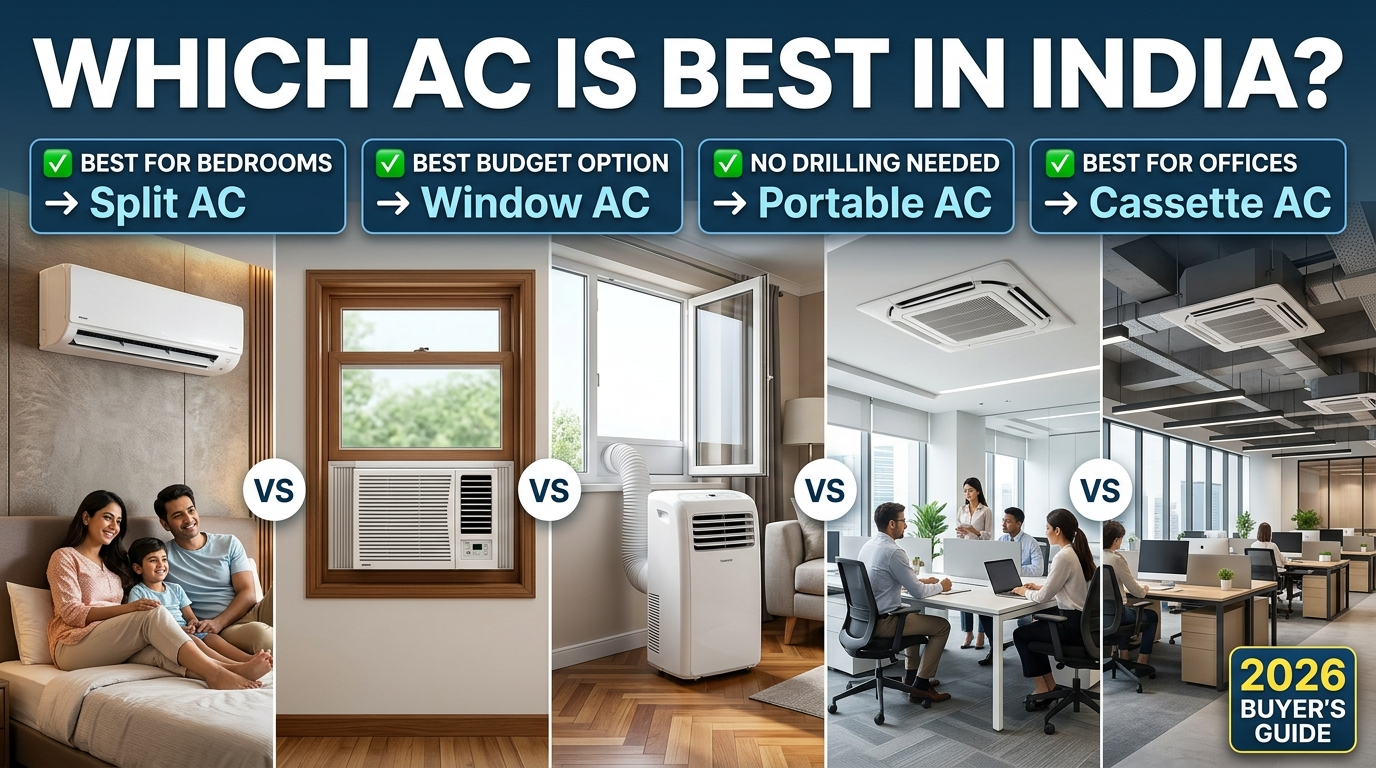
- Which AC Is Best in India? Split, Window, Cassette & More (2026)
- 1. Split AC (Best Type of AC for Bedrooms and Silent Cooling)
- 2. Window AC (Best Budget AC for Renters and Small Rooms)
- 3. Cassette AC (Best 4-Way Cooling for Modern Offices and Large Living Rooms)
- 4. Portable AC (Best No-Drilling Solution for Apartments and Kitchens)
- 5. Tower AC (Best Floor-Standing AC for Large Spaces and Commercial Halls)
- 6. VRF & Central Systems (Best Centralized AC for Luxury Villas and Full Corporate Floors)
- 7. Ground Realities & Showroom Secrets Google AI Won't Tell You
- 8. Hidden Installation Costs Nobody Tells You
- The Bottom Line: How to Make Your Final Choice
- Frequently Asked Questions (FAQs)
Thinking about buying a new air conditioner for your bedroom or office, but getting completely confused by all the options online? You aren’t alone.
In this guide, we compare Split ACs, Window ACs, Portable ACs, Cassette ACs, and Central AC systems to help you choose the best type of AC for Indian homes, apartments, offices, and rental spaces.
We will break down the 6 real-world types of ACs in India so you can pick the exact right model for your room size, building layout, and budget without wasting your hard-earned money.
Shopping Tip: If you still haven’t decided which tonnage or power capacity is best for your specific room dimensions, read our complete guide on How to Choose the Right AC to lock in your requirements first.
Quick Comparison of Different Types of ACs in India
| AC Type | Best For | Noise Level | Total Upfront Cost |
| Split AC | Master Bedrooms & Private Office Cabins | Super Low | Medium |
| Window AC | Small Rooms, Rented Flats & Tight Budgets | High Humming | Low |
| Portable AC | No-Drilling Rooms, Kitchens & Shifting Often | Medium | Medium |
| Cassette AC | Large Open Living Rooms, Cafes & Office Floors | Low | High |
| Tower AC | Large Gyms, Banquets & Glass-Wall Offices | Medium | High |
| VRF / Central | Whole Luxury Bungalows & Full Corporate Spaces | Near Silent | Very High |
1. Split AC (Best Type of AC for Bedrooms and Silent Cooling)
This is the most popular air conditioner hanging on bedroom walls across India today. It is called a “Split” AC because the machine is split into two separate units.
The clean, quiet indoor unit hangs inside your room to blow cold air, while the big, noisy compressor box sits outside on your balcony or wall bracket.
- Best For: Families, quiet master bedrooms, long daily heavy use, and silent cooling lovers.
Pros & Cons of Split ACs
- Pros: Super-quiet indoor operation, faster localized room cooling, sleeker wall aesthetics, and higher overall energy efficiency.
- Cons: Requires a 3-inch core hole drilled through your exterior wall, complex installation, and a higher upfront purchase price than window models.
2. Window AC (Best Budget AC for Renters and Small Rooms)
The old-school window AC is a single, boxy machine where every single mechanical part, including the compressor, is packed into one frame.
It sits directly inside a brick window opening or a square wooden cutout made in your room’s wall.
- Best For: Renters changing houses frequently, single students, small home offices, and strict upfront budget shoppers.
Pros & Cons of Window ACs
- Pros: Cheaper purchase price, zero complex wall piping, very easy to uninstall and pack up when shifting houses, and highly durable build.
- Cons: Distinct humming and clicking compressor noises, blocks natural window light, and is restricted only to rooms with pre-built wall cutouts.
Electricity Alert: Trying to calculate your future bills? Check out our expert breakdown on 3-Star vs 5-Star AC and see how the new 2026 BEE energy labeling laws directly change your monthly power usage.
Split AC vs Window AC Deep Comparison
| Feature Matrix | Wall-Hanging Split AC | Traditional Window AC |
| Split AC vs Window AC Cooling | Cools faster and distributes air much wider across the room. | Cools effectively but mostly blows air in a straight direction. |
| Split vs Window AC Power Consumption | High energy savings. Inverter split models drop power usage drastically. | Higher electricity bills. Window AC vs split ac energy consumption is always higher because of compact design limits. |
| Noise Levels | Super quiet operation (Perfect for heavy sleepers). | Distinct humming and compressor clicking sounds. |
| Room Size Suited | Available from 1 Ton up to 2.5 Ton for all room sizes. | Best for small rooms or medium square bedrooms only. |
3. Cassette AC (Best 4-Way Cooling for Modern Offices and Large Living Rooms)
A Cassette AC is a premium, square-shaped unit that sits flat and flush inside your decorative false ceiling.
Unlike a regular split AC that throws air in only one direction, this machine uses a powerful ceiling fan system to blow chilled air in all four directions at the same time.
- Best For: Open-plan corporate offices, premium home living rooms, retail showrooms, and modern cafes.
Pros & Cons of Cassette ACs
- Pros: 360-degree uniform airflow across the floor, hides all messy internal wiring behind the ceiling, and saves prime wall display space.
- Cons: Very expensive upfront machine cost, requires a deep false ceiling layout, and higher routine cleaning fees.
Split AC vs Cassette AC Comparison
| Buying Factors | Regular Wall Split AC | Ceiling Cassette AC |
| Air Delivery | One-directional throw (creates sudden cold spots). | 360-degree uniform circular throw across the room. |
| Wall & Ceiling Space | Takes up prime space on your main bedroom wall. | Completely hidden; only a clean panel shows on the ceiling. |
| Upfront Cost | Budget-friendly option for middle-class homes. | High price tag; requires premium upfront investment. |
4. Portable AC (Best No-Drilling Solution for Apartments and Kitchens)
Think of a portable AC as a standard window unit on wheels that stands directly on your floor like a regular plastic air cooler.
It requires zero permanent wall drilling, but you must hang a thick, flexible exhaust pipe out of a nearby window to throw the burning hot room air outside.
- Best For: Temporary pop-up shops, active cooking modular kitchens, and rental rooms where landlords strictly ban drilling holes.
Pros & Cons of Portable ACs
- Pros: 100% landlord-safe with zero permanent wall damage, fully movable across rooms on wheels, and instant plug-and-play operation.
- Cons: Noticeably louder operation inside the room, takes up valuable floor space, and struggles to deliver crisp cooling in peak summers.
Portable AC vs Window AC vs Split AC
| Feature | Floor Portable AC | Traditional Window AC | Wall Split AC |
| Drilling / Damage | 100% Landlord safe. Zero drilling needed. | Requires a large open window frame. | Requires drilling a 3-inch hole through the wall. |
| Mobility | Permanent fixture in a single wall gap. | Permanent fixture in one single wall gap. | Permanent fixture on the wall. |
| Cooling Efficiency | Lowest. Body heat stays inside the room. | High. Hot air stays completely outside. | Maximum. Highly efficient cooling cycles. |
5. Tower AC (Best Floor-Standing AC for Large Spaces and Commercial Halls)
A Tower AC is a tall, vertical, refrigerator-sized unit that stands independently in a corner of your room.
These are high-capacity cooling machines (usually starting from 2.5 Ton to 4 Ton+) designed to throw a massive column of air across huge open spaces.
- Best For: Corporate office reception lounges, gym workout floors, large restaurant halls, and independent residential bungalows.
Pros & Cons of Tower ACs
- Pros: Massive air throw power across long rooms, requires zero wall support, and handles crowded high-occupancy spaces easily.
- Cons: High floor footprint space, uses significant industrial-level power, and the strong air blast can feel uncomfortable if sitting directly in front of it.
6. VRF & Central Systems (Best Centralized AC for Luxury Villas and Full Corporate Floors)
Central air conditioning and VRF (Variable Refrigerant Flow) systems are built for entire buildings rather than individual single rooms.
Instead of cluttering your beautiful office exterior walls or home balconies with 8 different ugly outdoor units, these systems use just one giant master compressor unit on the terrace roof to cool the entire property.
- Best For: Multi-story luxury duplex houses, complete corporate office floors, hotels, and large commercial clinics.
Pros & Cons of VRF Central Systems
- Pros: 100% architectural design freedom for clean outer building walls, elite energy efficiency, and total centralized automation control.
- Cons: Sky-high entry installation prices, demands professional structural copper pipe mapping, and requires highly specialized technician care.
Central AC vs Cassette AC Comparison
| Operational Differences | Central Ducted AC System | Individual Cassette AC Setup |
| Temperature Control | Single central thermostat sets one uniform climate for the entire floor. | Every single room cabin can set its own independent temperature. |
| Installation Style | Uses huge sheet-metal ducts completely hidden behind the drywall panels. | Uses separate square units fitted into local ceiling panels. |
| Ideal For | Massive open-plan corporate layouts, malls, and theaters. | Multi-room premium flats, offices with cabins, and cafes. |
7. Ground Realities & Showroom Secrets Google AI Won’t Tell You
Standard tech blogs and AI overviews give you neat details copy-pasted straight out of brand catalogs.
But when you install an AC in a real Indian neighborhood, you quickly face local, messy complications that textbooks completely ignore.
The Housing Society Hole-Drilling Ban
Many modern residential complexes across major Indian metros now completely ban drilling 3-inch core holes through exterior walls. They worry it spoils the building’s outer uniform look or chips into structural concrete pillars. If your society enforces this rule, you cannot install a Split AC, forcing you onto a Window or Portable track immediately.
The “Negative Pressure” Portable AC Trap
Standard single-hose portable ACs continuously exhaust hot air out of your window. Because they throw air out without bringing fresh air in, they create a vacuum trap inside your room. Your bedroom will actively suck in hot, humid air from under the bathroom doors and main door gaps, leaving the ambient air feeling damp and sticky rather than chillingly crisp.
The False-Ceiling Access Nightmare
Showrooms love pushing hidden cassettes or Concealed ACs because they look incredibly luxurious. However, if a water drain line gets clogged or a wire burns out later, a local mechanic will literally have to chop open sections of your expensive decorative POP or Gypsum false ceiling to fix it. Always demand that your interior designer leave a dedicated, hidden Access Trap Door right next to the internal machine during installation.
The Local Market Spare Parts Filter
If a simple Window AC breakdown happens in the middle of a burning May heatwave, any local street mechanic can swap out a generic fan motor or capacitor in 2 hours for around ₹1,500. If a complex Split, Cassette, or VRF motherboard (PCB) fries due to local voltage fluctuations, generic parts won’t work, and you will be left sweating for 7 to 10 days waiting for official company warehouse stock to arrive.
8. Hidden Installation Costs Nobody Tells You
When you are buying an AC, the price tag you see online or at the showroom is never your final bill.
Depending on the installation type, your pocket will face different hidden costs before the machine actually starts cooling.
Estimated Extra Installation Costs by Type
| AC Type | Average Installation Charges | Extra Civil & Carpenter Work Needed |
| Window AC | ₹1,000 to ₹1,500 | Making a wood or brick frame inside the window gap. |
| Split AC | ₹1,500 to ₹3,000 | Core drilling through concrete walls for copper pipes. |
| Portable AC | Almost Free (DIY) | Sealing the window gap around the plastic exhaust pipe. |
| Cassette AC | ₹12,000 to ₹20,000 | Major false ceiling cutting, channel framing, and wood work. |
| VRF / Central | Custom Quote Only | Complete architectural design mapping and long piping runs. |
The Bottom Line: How to Make Your Final Choice
To make your final choice completely simple, locate your exact situation below to find your perfect match:
- Window AC vs split AC: which is best for renters? If you live in a temporary rented flat and move often, choose a Window AC to save on massive uninstallation and gas refilling costs.
- Which AC is best, window or split, for small rooms? If you have a small room under 120 sq ft, a 1 Ton Window AC is the most budget-friendly option. However, if you are a light sleeper, pick a Split AC to keep the compressor noise completely outside.
- Best option for an open office or retail shop floor: Buy a Cassette AC to get uniform 360-degree cooling without creating any annoying hot spots.
- Best option if your landlord or society bans wall drilling: Buy a floor-standing Portable AC that rolls on wheels and vents through a window pane.
- Best option for a luxury villa or multi-room workspace: Invest in a modern VRF System to keep your exterior walls clean and enjoy premium centralized cooling.
Still deciding between an AC and an air cooler? Read our guides on How to Choose the Right AC for Your Home in India (2026), Best Desert Air Coolers in India 2026, and Top 6 Best Air Coolers Under ₹6,000 to compare cooling performance, costs, and ideal use cases.
Frequently Asked Questions (FAQs)
Split AC vs Window AC: Which is actually better for my room?
If you want a modern look, absolute pin-drop silence, and have an empty wall with a balcony outside, a Split AC is the clear winner. A Window AC is only better if you are on a tight upfront budget, have an existing window frame ready, or live in a temporary rental home.
Split vs. window AC power consumption: Which one will save more on my electricity bill?
A Split AC will always save you significantly more electricity. Because Split ACs have large outer units, manufacturers can fit much bigger, highly efficient cooling coils inside them. Window ACs are restricted by their small box size, meaning even a 5-star window unit will consume more power than a 5-star split unit.
(Pro-tip: Double-check the label! Under the strict energy norms, many older models dropped star ratings. Always look for the fresh validity sticker for real savings.
Which is better for cooling, a split AC or a window AC?
A Split AC cools much better and faster. It is mounted high up near the ceiling, allowing it to throw cold air across the entire length of the room. A Window AC is mounted lower down, meaning its airflow is limited and mostly blows straight at your bed or seating area.
Is a portable AC worth buying for an Indian home?
A portable AC is only worth buying as a last resort. If you live in a society that bans wall drilling, or your landlord refuses to allow a split AC installation, then it is a useful solution. If you can install a Split or Window AC, buy those instead, as portable ACs are louder and consume more power.
Split AC vs. window AC life: Which one lasts longer over the years?
A Window AC generally lasts longer and has a lower maintenance cost because it is built as a single, rugged box with zero hidden internal piping. Split ACs have delicate electronic motherboards (PCBs) and long copper pipes running through walls, making them more prone to gas leaks or circuit damage after 5 to 6 years if not serviced regularly.
Is a split AC actually better than a window AC for a small room, or is it a waste of money?
If your room is under 120 sq ft, a window AC will cool it perfectly fine for less upfront money. However, a split AC is not a waste of money if you value absolute silence. A window AC has the entire noisy compressor sitting directly inside your wall frame, which can disturb your sleep.
Why are portable split air conditioners not common in India? What’s the catch?
Portable split units require you to manually carry a heavy outdoor compressor box and hang it outside your window using safety straps every single time you move the machine. Because this is highly unsafe for high-rise apartments and costs a lot of money, Indian buyers prefer standard floor portable units with a flexible exhaust pipe instead.
Does a portable AC cause higher humidity inside the room compared to a window AC?
Yes, standard single-hose portable ACs create a negative air pressure trap. As they push hot air out of the exhaust pipe, they actively suck warm, humid air from your kitchen or door gaps back into the room, making it feel slightly sticky and damp.
Is a portable AC a good alternative to an inverter split AC in terms of effectiveness?
No. A portable AC should only be your last resort if your landlord completely bans wall drilling or your building rules forbid hanging an outdoor unit. In terms of cooling effectiveness and electricity bills, an inverter split AC will always win because its compressor stays completely outside the room.
Dual-hose portable AC vs window AC: Which one is more efficient?
A window AC will always be significantly more efficient than any portable AC. Even though a dual-hose portable AC is much better than a single-hose model (because it doesn’t create a vacuum trap), the entire hot machine still sits inside your room, radiating body heat back into your living space.
Can I install a Cassette AC if my space doesn’t have a false ceiling?
Technically you can mount it to a bare concrete ceiling, but it will look highly unpolished because all the messy water drain lines and copper pipes will hang down in plain sight. If you don’t have a decorative false ceiling, stick to a regular Split AC.
Central AC vs VRF system: What is the most cost-effective way to cool a 3 BHK flat or a 10-room independent home?
For residential homes, a VRF system is much more cost-effective. A traditional central ducted AC cools the entire floor uniformly, meaning you waste energy cooling empty rooms. A VRF system lets you set independent temperatures or completely turn off the AC in rooms you aren’t using.